CWDM vs DWDM MUX selection is not simply a question of how many wavelengths are needed today. The right choice depends on the channel plan, installed fiber, end-to-end optical budget, topology, and whether the network may require more capacity or a different transport design later.
A passive MUX/DEMUX can carry multiple optical signals over a shared fiber path by assigning each signal a different wavelength. That can reduce the number of fibers required between sites and help organize multi-service links. However, the MUX itself is only one part of a working WDM link. The selected optics, fiber route, connectors, splices, patching, and future design requirements all matter.
As a practical starting point, CWDM is often considered for lower-density wavelength plans with clearly defined requirements. DWDM is generally evaluated where finer channel planning, higher wavelength density, or longer-term network evolution is important. Neither is automatically the better option. The link budget and equipment compatibility should make the final decision.
What Is a CWDM or DWDM MUX?
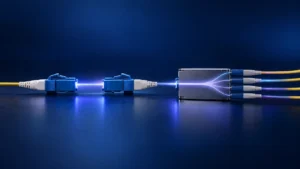
A wavelength division multiplexing MUX combines multiple wavelength-specific optical signals onto a common fiber path. At the remote end, a DEMUX separates those wavelengths so each receiving port can connect to its corresponding optical module or equipment interface.
- Channel port: A port assigned to a CWDM wavelength or DWDM ITU channel.
- Common port: The shared port that carries combined wavelengths toward the fiber link.
- Express port: A pass-through path used where wavelengths continue beyond an intermediate node.
- Upgrade port: A port reserved for a future wavelength range or network-evolution path, depending on the design.
- Monitor port: A low-power tap intended for measurement or monitoring.
Passive MUX/DEMUX units do not perform optical-to-electrical conversion. The active optical modules and network equipment still determine data rate, reach capability, diagnostics, and protocol compatibility. A MUX selection must therefore be coordinated with the complete optical-channel design.
CWDM vs DWDM MUX: The Grid Difference
CWDM Wavelength Grid
CWDM uses a wavelength-based grid. ITU-T G.694.2 defines a CWDM wavelength grid with 20 nm channel spacing. The wider spacing can simplify wavelength planning, but it does not eliminate the need to verify the actual channel plan.
For a CWDM project, specify the exact wavelengths required rather than relying only on a description such as “8-channel CWDM.” The selected wavelengths must be reviewed against the installed fiber condition, active optics, and full loss budget.

DWDM Frequency Grid
DWDM uses a frequency-based grid defined by ITU-T G.694.1. In procurement and engineering discussions, DWDM wavelengths are often identified by their ITU channel references and selected spacing.
This finer grid supports more closely packed channels than CWDM, but it also makes consistent channel planning more important. Every selected MUX channel, optical module, and far-end port must match the intended ITU plan.

CWDM vs DWDM MUX Comparison Table
| Decision factor | CWDM MUX | DWDM MUX | Buyer check |
|---|---|---|---|
| Grid basis | Wavelength grid | Frequency / ITU channel grid | Exact wavelength or ITU-channel plan |
| Channel spacing | 20 nm under ITU-T G.694.2 | Depends on the selected DWDM grid | Compatibility between MUX ports and optical modules |
| Typical planning direction | Lower-density, defined wavelength requirements | Finer channel planning and higher-density requirements | Current channels plus future capacity |
| Link-budget focus | Full fiber path and both end units | Full loss, channel consistency, and system planning | Worst-case channel margin |
| Future evolution | Confirm a suitable path forward | Review channel plan, topology, and architecture | Expansion and equipment roadmap |
In a CWDM vs DWDM MUX comparison, actual performance depends on the selected component configuration and the complete link.
For terminology and grid reference, consult the ITU-T G.694.1 DWDM grid recommendation and the ITU-T G.694.2 CWDM grid recommendation when confirming a project-specific channel plan.
How to Choose Between CWDM and DWDM MUX
Start With the Required Channel Plan
Begin with the services that must operate on the route today, then document reserve capacity separately. The objective is not to buy the highest channel count by default; it is to select a channel plan that supports required services without unnecessary complexity or loss.
Verify Fiber Type, Route Length and Existing Infrastructure
Review the fiber type, actual route length, connector interfaces, patch panels, splice locations, and any existing passive components. Use the installed cable path rather than a straight-line distance between buildings.
This is also the point to confirm whether one fiber or a fiber pair is available. Single-fiber and dual-fiber designs use different channel arrangements and require careful end-to-end pairing. For single-fiber designs, confirm the directional wavelength pairing and the matching A-end and B-end configuration before ordering.
Calculate the Full Optical Link Budget
The calculation should include fiber attenuation across the actual route, insertion loss from the MUX/DEMUX at both ends, connector and adapter losses, splice losses, loss from additional passive elements, engineering margin, and the transmitter and receiver specifications of active optical modules.
A point-to-point WDM link normally has passive equipment at both ends. Therefore, the loss of both units must be accounted for. Use the worst applicable channel in the calculation.

Plan for Future Capacity and Amplification
Before choosing a wavelength plan, ask whether the route may later need more channels, a different topology, or additional optical-system functions. The future path must remain compatible with the wavelength plan, fiber route, active optics, and loss budget.
Choose Topology and Port Functions
A simple point-to-point link may only need matching channel and common ports at both ends. A ring, chain, or intermediate-node topology may require express paths, add/drop functions, or other carefully planned passive paths. For multi-node networks, evaluate the longest through path first.
When CWDM MUX Is the Better Fit
CWDM MUX may be suitable when the wavelength requirement is limited, the channel plan is clearly defined, and the installed route has been reviewed against the proposed optical design. The buyer should confirm planned wavelengths, paired-end configuration, active modules, fiber route, and possible future expansion before ordering.
When DWDM MUX Is the Better Fit
DWDM MUX may be a better direction when a project requires finer channel planning, higher wavelength density, or a design that needs detailed ITU-channel coordination. It should be treated as a complete-system decision: MUX channel plan, optical modules, equipment support, fiber path, and complete budget must be reviewed together.
Illustrative Selection Scenario
The following is an illustrative planning example, not a VIBOFIBER customer case or product recommendation.
A team needs to carry several services between two sites over an existing fiber route. It first confirms the actual route length, available fiber count, connector path, active interfaces, current channel plan, and reserve capacity. It then includes the loss of both end MUX/DEMUX units in the optical budget.
If the required wavelength plan is limited and the verified link budget has sufficient margin, the team may evaluate a CWDM design. If the project needs denser channel planning or a future network architecture based on detailed ITU-channel coordination, it may evaluate a DWDM design. In either case, final selection depends on verified optics, fiber conditions, and the end-to-end optical budget.
CWDM vs DWDM MUX Purchase Checklist
- Required CWDM wavelengths or DWDM ITU channels
- Current channel requirement and expected reserve capacity
- Single-fiber or dual-fiber design
- Matching far-end MUX/DEMUX configuration
- Package format and mounting environment
- Connector interface requirements
- Common, express, upgrade, or monitor port requirements
- Fiber type, route length, connector count, and splice count
- Active optical-module wavelength and equipment compatibility
- Full optical link-budget calculation and required margin
Safety Notice
High-speed optical and fiber connectivity work should be performed by trained personnel in accordance with applicable site procedures, equipment documentation, and local regulations.
- Do not look into active fiber connectors, transceivers, cable ends, or optical ports.
- Verify link status before handling or inspecting an optical interface.
- Inspect and clean optical end faces with approved methods before connection.
- Follow appropriate ESD practices when handling active modules and network equipment.
- Observe applicable bend-radius, pulling-force, pathway, labeling, grounding, and fire-safety requirements.
- Collect and dispose of fiber shards safely using approved site procedures.
- Treat this article as general selection guidance. Confirm the final channel plan, optical budget, equipment compatibility, and site requirements before deployment.
Frequently Asked Questions
Can CWDM and DWDM Be Used on the Same Fiber?
They may be considered together only after a complete wavelength plan, filter-compatibility review, and loss-budget calculation. Do not assume all CWDM and DWDM wavelengths can be combined.
Does a Passive MUX Need Power?
A passive MUX/DEMUX does not normally require electrical power for optical filtering. The complete link may still include active optical modules, network equipment, monitoring devices, or other powered equipment.
Why Is Insertion Loss Important in a WDM Link?
Insertion loss reduces optical power available at the receiver. It must be calculated with fiber attenuation, connector losses, splice losses, and other passive-path losses.
What Information Should I Send for a CWDM or DWDM MUX Quote?
Provide the wavelength or ITU-channel plan, fiber route length and type, single- or dual-fiber design, topology, active-interface requirements, connector type, package preference, port functions, and future capacity expectations.
Need Help Selecting a CWDM or DWDM MUX?
Contact VIBOFIBER to discuss your project requirements and request current product and configuration information.