Selecting the right fiber optic connector affects port density, optical performance, installation speed, equipment compatibility, and future network expansion. For most projects, the practical choices are LC, SC, FC, ST, and MPO/MTP. This guide explains how to select the right interface for data centers, FTTH, PON, test systems, and high-density fiber links.
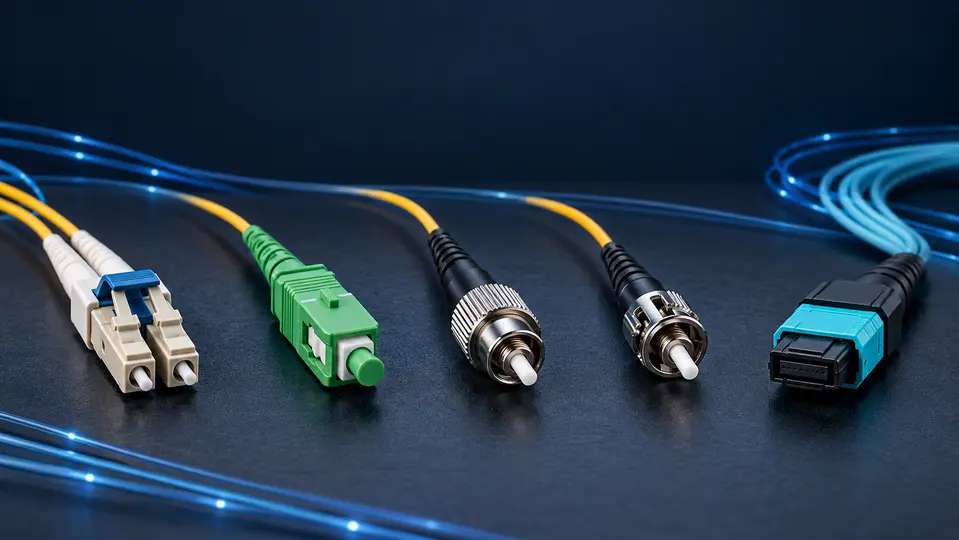
Fiber Connector Comparison at a Glance
| Connector | Typical Fiber Count | Best-Fit Application | Key Advantage |
|---|---|---|---|
| LC | 1–2 | Data centers and transceiver ports | High port density |
| SC | 1–2 | FTTH, PON and telecom access | Reliable push-pull mating |
| FC | 1 | Test and measurement | Vibration-resistant threaded coupling |
| ST | 1 | Legacy multimode networks | Secure bayonet lock |
| MPO/MTP | 8, 12, 16, 24+ | Data center trunks and parallel optics | Multiple fibers in one mating |
Choose a Fiber Connector by Application
Data Centers and Transceiver Connections
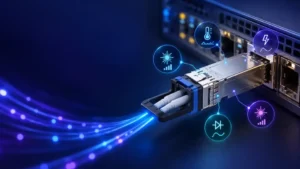
LC is the standard choice for most duplex patching in data centers and enterprise networks. Its compact 1.25 mm ferrule supports high-density patch panels, while LC duplex interfaces are widely used with SFP, SFP+, and SFP28 optical modules. For trunk links carrying multiple fibers between cabinets, MPO/MTP is generally the better option. Learn more about data center connectivity solutions from VIBOFIBER.

FTTH and PON Networks
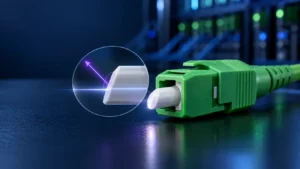
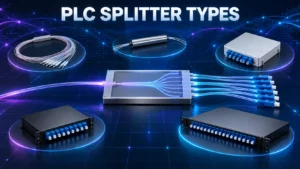
SC connectors are widely used in fiber-to-the-home and passive optical network installations. SC-APC is commonly specified for splitter-based PON links because the angled polish helps control back reflection. Confirm the equipment interface before ordering, especially for ONT, splitter, and fiber distribution connections. See VIBOFIBER FTTH network solutions for application support.

Test, Legacy, and Harsh Environments
FC remains useful for test equipment and stable measurement setups because its threaded coupling resists movement. ST is mainly selected for maintenance of existing multimode infrastructure. For outdoor or industrial applications, do not assume an indoor LC or SC assembly is suitable: verify the cable jacket, connector housing, and environmental protection rating.
Main Fiber Optic Connector Types Explained
LC Connector
LC uses a compact latch and a 1.25 mm ferrule. It is available in single-mode and multimode versions, as simplex or duplex assemblies, and is the practical default for high-density optical-module and patch-panel connections.
SC Connector
SC uses a 2.5 mm ferrule and a push-pull latching mechanism. SC-APC is particularly common in FTTH and PON networks, while SC-UPC is used in standard telecom and fiber distribution applications.
FC Connector
FC uses a threaded metal body that provides stable mating. It is still common on certain optical power meters, OTDRs, and legacy single-mode test links.
ST Connector
ST uses a bayonet twist-lock connection. It is mostly found in earlier multimode LAN and campus installations, and is usually selected only when matching an installed cable plant.
MPO/MTP Connector
MPO/MTP connectors use a rectangular multi-fiber ferrule and are available in 8-, 12-, 16-, and 24-fiber configurations. They are used for high-density trunks, cassettes, breakout assemblies, and parallel-optic links. Order specifications must include fiber count, polarity method, gender, key orientation, fiber mode, and cable configuration.
Specifications to Confirm Before Ordering
- Fiber mode: Match OS2 single-mode or OM3, OM4, or OM5 multimode fiber to the link and active equipment.
- Simplex, duplex, or multi-fiber: Duplex LC suits most two-fiber transceiver links; MPO/MTP is for multi-fiber trunks.
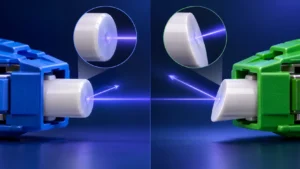
- Polish type: UPC is typical for digital data links; APC is commonly used in reflectance-sensitive FTTH, PON, and CATV applications.
- MPO/MTP polarity: Keep trunk, cassette, and harness polarity consistent across the entire link.
For custom lengths, fiber counts, connector combinations, and passive-component configurations, explore custom fiber optic components.
Common Connector Selection Mistakes
- Using LC for every project: LC is excellent for data centers, but SC-APC is normally the more compatible choice for many FTTH and PON deployments.
- Mixing APC and UPC: Green APC and blue UPC connectors must never be mated. The different end-face geometries can produce high loss, high reflection, and ferrule damage.
- Ignoring fiber mode: A connector may look similar on OS2 and multimode assemblies, but the fiber specifications are different.
- Overlooking MPO/MTP polarity: A physical connection can mate while transmit and receive paths remain crossed.
- Using indoor assemblies outdoors: Select appropriate sealing and environmental protection for the installation.
A Simple Connector Selection Checklist
- Identify the deployment environment: data center, FTTH, telecom, laboratory, campus, or outdoor.
- Confirm single-mode or multimode fiber.
- Confirm the required fiber count.
- Match the connector to the equipment interface.
- Confirm UPC or APC polish.
- For MPO/MTP, specify polarity, gender, key orientation, and breakout configuration.
Safety Notice
- Never look directly into the end of a fiber optic cable, connector, or active optical port. Invisible laser light can cause eye injury.
- Never mate APC and UPC interfaces together.
- Inspect and clean connector end faces before mating to reduce loss and prevent contamination-related faults.
- Follow site laser-safety procedures during testing and commissioning.
- Dispose of fiber offcuts in a designated container to avoid skin or eye injury.
Frequently Asked Questions
What are the most common fiber optic connector types?
LC, SC, FC, ST, and MPO/MTP are the connector types most often encountered in modern and legacy fiber networks.
Is LC better than SC?
Neither is universally better. LC is the normal choice for high-density data center and transceiver interfaces, while SC is widely used for FTTH and PON applications.
When should I use MPO/MTP instead of LC?
Use MPO/MTP when a single connection must carry multiple fibers, such as in data center trunk cabling or parallel-optic links. Use duplex LC for standard two-fiber transceiver connections.
Can SC and LC connect directly?
No. Use a hybrid patch cord with SC on one end and LC on the other, while keeping fiber mode and polish type compatible.
Need Help Selecting the Right Fiber Connector?
VIBOFIBER supplies passive fiber optic components and custom fiber assemblies for data centers, telecom networks, FTTH projects, and optical transceiver applications. Visit the VIBOFIBER fiber optic knowledge center for related guides, or request a quick quote with your connector type, fiber mode, length, polish, fiber count, and application requirements.