What Is an APC Fiber Connector? 8° Polish, APC vs UPC & Selection Guide
n
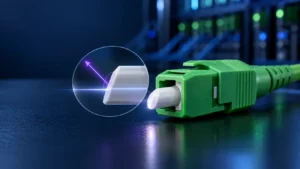
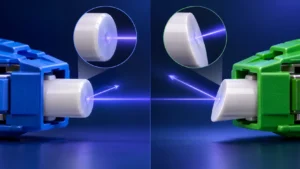
An APC fiber connector is a fiber optic connector with an angled physical contact end face. The connector ferrule is polished at an 8° angle, which directs reflected light away from the fiber core instead of sending it back toward the optical source.
n
This matters in single-mode links where back reflection can affect signal quality, measurement stability, or system performance. APC connectors are commonly considered for FTTH and PON networks, reflection-sensitive optical distribution links, and other systems whose equipment or design documents specify an APC interface.
n
For buyers and project teams, the key point is simple: APC is not a universal upgrade over UPC. The correct choice depends on the equipment port, the optical link design, and the required connector interface.
n
What Is an APC Fiber Connector? Meaning and 8° Polish
n
APC stands for Angled Physical Contact.
n
A fiber connector joins two optical fibers through a precisely aligned ferrule and mating interface. With APC polish, the ferrule end face is angled rather than nearly perpendicular to the fiber axis. That geometry helps reflected light leave the guided path instead of returning directly toward the transmitter or test source.
n
APC describes the polish style, not the connector body by itself. For example:
n
- SC/APC means an SC connector with APC polish.
- LC/APC means an LC connector with APC polish.
- FC/APC means an FC connector with APC polish.
- MPO/APC means an MPO connector with APC polish.
n
Always read both parts of the designation. The first part identifies the fiber optic connector type; the second identifies the end-face polish.
n
How the 8° APC End Face Reduces Back Reflection
n
Every mated fiber connection can produce a small amount of reflected optical power. A connector’s end-face geometry affects where that reflection travels.
n
With an APC connector, the 8° angled polish directs much of the reflected light away from the fiber core. This improves reflection control in links where return loss is an important design consideration.
n
It is useful to distinguish two different measurements:
n
| Measurement | What It Describes | Desired Direction |
|---|---|---|
| Insertion loss | Optical power lost while light passes through a connection | Lower is generally better |
| Return loss | Optical power reflected back toward the source | Higher is generally better |
n
APC selection is mainly about controlling back reflection. It should not be treated as a shortcut for solving every insertion-loss or link-budget problem.
n
APC vs UPC: Key Differences
n
APC and UPC are both polished connector interfaces, but their end-face geometry is different.
n
| Feature | APC | UPC |
|---|---|---|
| Full name | Angled Physical Contact | Ultra Physical Contact |
| End face | Angled polish | Smooth, rounded physical-contact polish |
| Typical single-mode identification | Often green | Often blue |
| Main selection reason | Reflection control | Common general-purpose physical-contact interface |
| Mating rule | Mate APC to APC | Mate UPC to UPC |
n
For a deeper comparison of polish types, see APC vs UPC fiber connectors.
n
Color can be a helpful field-identification cue, but it is not a substitute for checking the connector label, equipment documentation, and project specification.
n
The most important rule is not to force-mate APC and UPC connectors. Their end-face geometries do not match. A mismatched connection can create abnormal loss, reflection issues, or damage to the connector end faces.
n
Where Are APC Fiber Connectors Used?
n
APC connectors are often specified where reflected light needs careful control. Typical examples include:
n
FTTH and PON Networks
Many fiber-to-the-home and passive optical network designs use APC interfaces at defined points in the optical distribution network. However, a project should follow the interface specified by the active equipment, splitter, terminal, adapter, or installed network standard.
n
CATV and RF-over-Fiber Links
Analog optical signals can be sensitive to reflections. APC may be selected when the equipment interface and network design call for an angled-polish connection.
n
WDM and Reflection-Sensitive Optical Links
Some WDM, amplified, test, or specialized optical links may require APC interfaces to manage reflected power. The decision must be based on the actual port type and system documentation—not on a general assumption that every WDM link uses APC.
n
Optical Testing
Test equipment, launch cords, and reference cables must match the port and test method. Before ordering a test lead, verify the instrument interface and the required connector polish.
n
Common APC Connector Types
n
SC/APC
SC/APC is widely encountered in single-mode access-network environments. The SC form factor identifies the push-pull connector body, while APC identifies the angled end-face polish.
n
LC/APC
LC/APC uses the compact LC connector form factor with APC polish. It may appear in systems that need the smaller LC interface while also requiring an angled-polish connection.
n
FC/APC
FC/APC uses a threaded FC connector body and APC polish. It may be encountered on certain test, laboratory, legacy, or specialized optical interfaces.
n
MPO/APC
MPO/APC combines a multi-fiber MPO interface with APC polish. For multi-fiber links, interface type, polarity, fiber count, and the connected equipment must all be checked together.
n
Can APC and UPC Connectors Be Mated?
n
No. APC and UPC connectors should not be directly mated or forced together.
n
Even when two connectors appear mechanically similar, the polished end faces are different. Forcing a mismatch can damage the end faces and may cause high loss or unacceptable reflection.
n
If two systems use different interfaces, the correct solution may be a properly specified transition assembly or a redesign of the interconnect point. Do not use adapters or patch cords as a workaround until the complete optical path has been reviewed.
n
How to Specify an APC Connector, Patch Cord, or Pigtail
n
A clear purchase request helps prevent incorrect components from arriving on site. Include the following information:
n
- Connector family
Specify SC, LC, FC, MPO, or another required interface. - Polish type
State APC explicitly. Do not rely only on connector color. - Fiber mode
Confirm whether the project uses single-mode or multimode fiber. - Simplex, duplex, or multi-fiber format
Match the cable construction and port arrangement to the link design. - Cable or pigtail configuration
State the required length, termination arrangement, and any project-specific construction requirements. - Adapter and panel compatibility
Check that adapters, patch panels, and equipment ports are designed for the specified connector family and polish type. - Documentation requirements
If the project requires insertion-loss, return-loss, or inspection documentation, state this in the RFQ and confirm the applicable acceptance criteria before ordering.
n
A complete description such as “SC/APC single-mode simplex patch cord” is more useful than simply requesting a “green fiber cable.” The more clearly the interface is specified, the lower the risk of a costly mismatch during installation.
n
Inspection, Cleaning, and Safe Handling
n
Connector cleanliness and end-face condition affect every optical connection, including APC connections.
n
Before mating a connector:
n
- Inspect the end face with appropriate fiber inspection equipment.
- Clean the connector with a suitable fiber-optic cleaning method.
- Inspect again after cleaning.
- Confirm that the connector family and polish type match the receiving port.
- Make the connection without forcing the ferrule.
n
If an end face is scratched, chipped, or otherwise damaged, cleaning alone may not resolve the problem. Follow the project’s inspection and replacement procedure.
n
Safety Notice
n
Do not look directly into a fiber connector, open fiber end, transceiver port, or active optical device. Optical radiation may be invisible and can damage eyes.
n
Before inspecting, cleaning, or reconnecting fiber components, follow the site safety procedure and confirm that the link is inactive or safe to handle. Keep dust caps in place when connectors are not in use, use appropriate inspection and cleaning tools, and never force an APC connector to mate with a UPC connector.
n
FAQ
n
Is an APC connector always green?
Green is a common visual identifier for single-mode APC connectors, but color alone is not enough for project acceptance. Confirm the connector marking, equipment port, and product documentation.
n
Is APC only used with single-mode fiber?
APC is most commonly associated with single-mode applications. The correct fiber mode and connector polish must always match the project design and equipment interface.
n
Is APC better than UPC?
Neither is universally better. APC is selected when reflection control is required and the system specifies APC. UPC is widely used where the equipment and link design specify UPC. Match the interface rather than choosing by appearance.
n
What does SC/APC mean?
SC describes the connector family. APC describes the angled physical-contact polish on the connector end face.
n
What should I confirm before ordering APC components?
Confirm the equipment port, connector family, polish type, fiber mode, cable configuration, adapter compatibility, required documentation, and any project-specific acceptance requirements.
n
Conclusion
n
An APC fiber connector uses an angled end face to help manage back reflection in the right optical links. Its value comes from correct system matching—not from using it everywhere.
n
Before placing an order, verify the equipment interface and complete optical path. For project-specific configuration questions, contact VIBOFIBER with the connector interface, fiber mode, application, and documentation requirements so the requested configuration can be checked against your design.