Choosing between DAC, AOC and ACC is not simply a question of buying the lowest-cost cable. For high-speed server, switch and storage links, the best option depends on link length, port type, signal requirements, cable routing, power budget and the way the connection may need to change over time.
This guide explains the practical differences between DAC vs AOC vs ACC so that data center teams, system integrators and procurement professionals can make a more confident shortlist before requesting product-specific confirmation. A clear DAC vs AOC vs ACC decision starts with the real link requirement, not a generic cable preference.
DAC, AOC and ACC: The Fast Definitions
Before comparing the options, it helps to separate the terms clearly.
- DAC (Direct Attach Copper): A copper cable assembly with pluggable ends. Passive DACs generally do not use active signal-conditioning electronics.
- ACC (Active Copper Cable): A copper cable assembly that includes electronics for signal conditioning. The exact design and terminology can vary by supplier and product family.
- AOC (Active Optical Cable): A fixed cable assembly that uses optical fiber with active electronics integrated into the cable ends.
In this guide, “DAC” refers primarily to passive direct attach copper unless a product specification states otherwise. Active copper terminology, including ACC and AEC, should always be confirmed against the relevant product data sheet.
These categories are useful for planning, but they are not a substitute for a product data sheet. A cable’s available length, port support, power characteristics, breakout options and compatibility must always be verified against the exact speed, port form factor and host equipment.
DAC vs AOC vs ACC at a Glance
| Comparison Point | DAC | ACC | AOC |
|---|---|---|---|
| Primary medium | Copper | Copper | Optical fiber |
| Active electronics | Usually none in passive DAC designs | Yes, for signal conditioning | Yes, integrated at cable ends |
| Typical planning use | Very short, fixed links | Copper links requiring more signal support | Fixed links where optical cable handling is preferred |
| Cable handling | Can be thicker and less flexible at higher speeds | Can share copper routing considerations | Often lighter and easier to route than comparable copper assemblies |
| Power planning | Often the simplest option to assess | Requires active-cable power consideration | Requires active optical cable power consideration |
| Service approach | Replace the complete cable assembly | Replace the complete cable assembly | Replace the complete cable assembly |
| Key purchase check | Reach, gauge, host support | Host support, coding, thermal and reach requirements | Length, host support, routing and fixed-assembly requirements |
The table is a decision framework, not a universal performance chart. Actual products can differ substantially by speed generation, port form factor and supplier design.
When DAC Is the Practical Choice
DAC is often the first option to evaluate when two devices are located close together. In a short, fixed connection, a passive copper assembly can offer a straightforward topology with no optical modules or separate patch cords to manage.

This makes DAC worth considering for tightly located switch-to-server, switch-to-storage or in-rack connections where the planned cable route is short and stable.
However, copper routing deserves attention. As speeds increase, cable diameter, bend behavior and rear-of-rack congestion can become important design factors. A cable that works electrically may still create an awkward installation if it blocks airflow, strains a port, or leaves no room for orderly service loops.
Before choosing DAC, confirm the required port type and data rate, exact cable length after allowing for routing, straight-through or breakout configuration, device support, coding requirements, rack layout, bend space and airflow considerations.
When ACC Makes Sense
In a DAC vs AOC vs ACC comparison, ACC can be a useful middle ground when a project still prefers a copper interconnect but the signal requirements are beyond what a passive copper option can reliably support.
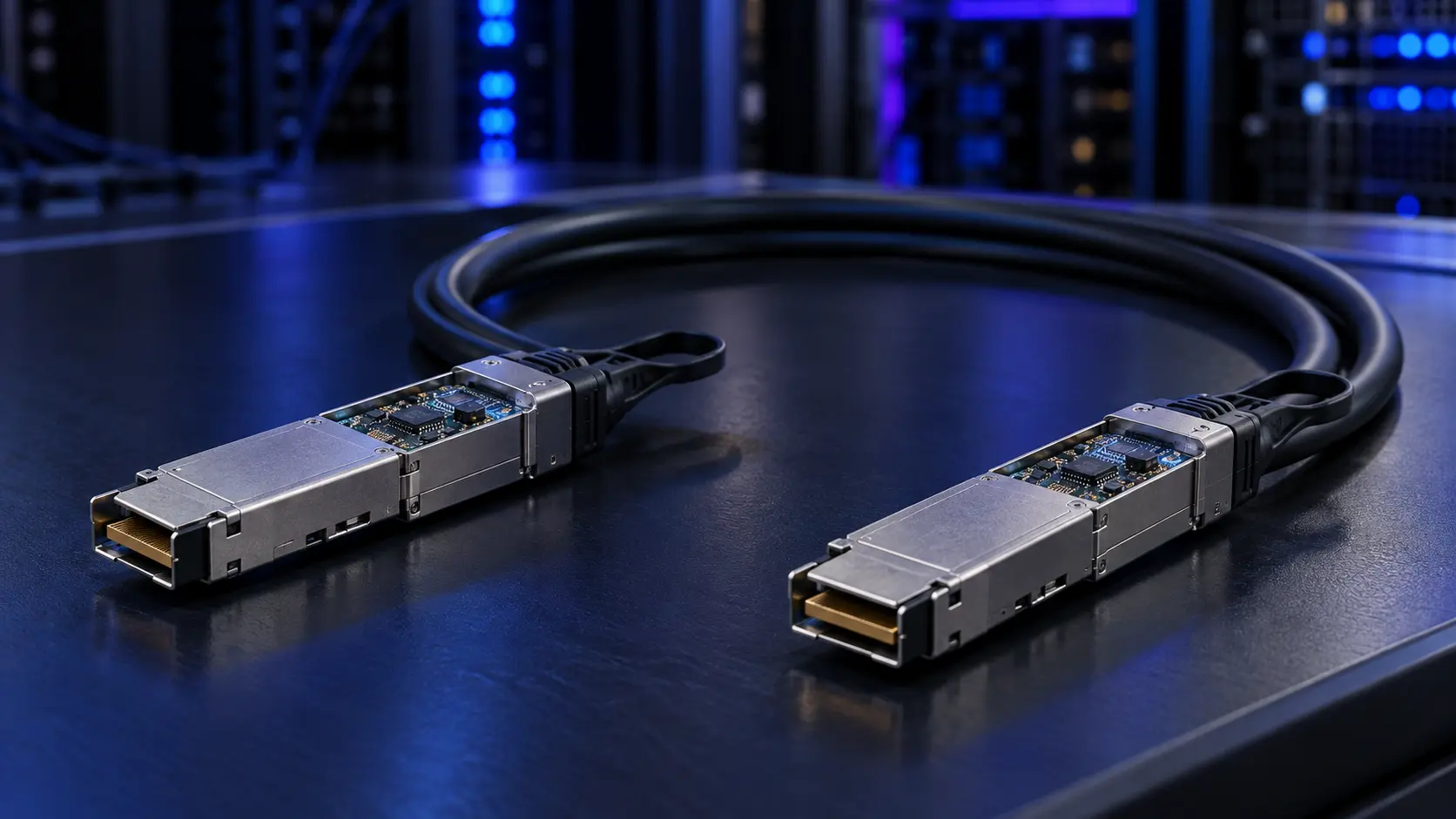
Unlike a passive DAC, an ACC includes active electronics that help condition the electrical signal. Depending on the product architecture, this may help extend usable copper deployment beyond a passive option. The terminology is important here: some suppliers distinguish ACC from AEC, while others use related descriptions differently. An active electrical cable reference also explains why the exact product architecture matters. A project should therefore compare the exact product specification rather than assume that all active-copper cables behave the same way.
ACC may deserve consideration when a passive DAC does not meet the intended cable route, the link remains a fixed point-to-point copper connection, the team needs to balance cable reach, power and routing constraints, and the host platform has confirmed support for the required active cable type.
Active copper should not be selected on length alone. Verify that both endpoints support the proposed cable, including the relevant port form factor, breakout mode, coding requirement and software or firmware conditions.
When AOC Is a Better Fit
For a DAC vs AOC vs ACC decision, AOC uses optical fiber inside a pre-terminated cable assembly. For many fixed point-to-point links, it offers a practical way to move from copper-based routing to a lighter optical cable without designing a separate transceiver-and-patch-cord link.

AOC can be worth evaluating when the cable path is longer than a practical copper route, when cable bulk is becoming difficult to manage, or when the installation benefits from a more flexible optical assembly.
The trade-off is that an AOC is normally a fixed assembly. The cable length and end configuration should be selected deliberately before purchase. If one end or the cable is damaged, the usual maintenance path is to replace the complete assembly.
For connections that must be frequently re-patched, extended in the future, or integrated into a structured fiber design, separate transceivers and fiber infrastructure may be the more flexible design.
DAC vs AOC vs ACC: 6 Selection Factors
1. Required Link Length
Start with the real cable route, not the straight-line distance between devices. Include vertical routing, side routing, cable-management paths and a sensible service allowance. Do not assume that a cable length used successfully at one speed will be appropriate at a higher speed.
2. Port Form Factor and Speed
Check the device port and intended data rate first. The form factor, breakout requirement and host configuration all influence which cable assemblies are valid options.
3. Host Compatibility and Cable Coding
Compatibility is a project requirement, not an afterthought. When requesting a quote, provide equipment manufacturer and model, port type, target speed, required cable length, breakout requirement and relevant software or firmware information where available.
4. Rack Density, Routing and Airflow
Cable management has direct operational value. A crowded cable area can make maintenance slower, restrict access to ports and complicate airflow planning.
5. Power and Thermal Budget
Passive and active cable assemblies do not have the same power considerations. For a large deployment, review the complete rack or row design instead of treating each cable as an isolated purchase.
6. Maintenance, Spares and Future Changes
DAC, ACC and AOC are generally fixed cable assemblies. If requirements change, the practical solution may be to replace the cable with a different length or configuration.
Common DAC, AOC and ACC Selection Mistakes
- Choosing only by unit price: The lowest cable price may not be the lowest project cost if it leads to difficult routing, repeated replacements or compatibility delays.
- Reusing old reach assumptions: Confirm the precise combination of speed, form factor and cable assembly.
- Ignoring breakout requirements: Equipment ports must support the required split configuration and device-side setup may be needed.
- Skipping compatibility details: Share host equipment details and intended use so compatibility can be checked before installation.
- Overlooking physical installation conditions: Review cable length, bend space, pathways, port access and airflow before ordering.
Pre-Purchase Compatibility Checklist
- What are the two endpoint devices and their exact port types?
- What speed must the link support?
- Is the connection straight-through or breakout?
- What is the measured cable route, including management path?
- Does the host require a specific cable coding or compatibility approach?
- Is the proposed cable length supported at the required speed?
- Are power and thermal considerations documented for the exact cable?
- Does the rack have enough routing and bend space?
- Is the link intended to remain fixed, or will it be reconfigured later?
- What spare-cable plan is appropriate for the site?
How VIBOFIBER Can Support Your Connectivity Planning
A reliable interconnect decision starts with complete project information. VIBOFIBER can discuss fiber connectivity and custom configuration requirements based on your confirmed equipment, port, speed, cable route and deployment needs.
For a more accurate discussion, prepare the endpoint device details, target data rate, cable length, port form factor and any breakout requirement before requesting product information.
Safety Notice
Before installing, replacing or troubleshooting any interconnect assembly, follow the equipment manufacturer’s power, ESD, port-handling and site-safety procedures.
Do not force a connector into a port that does not match the required form factor. If a cable, connector or port shows signs of damage, unusual heating, contamination or repeated link alarms, stop work and have qualified personnel inspect the affected equipment.
Final compatibility, supported length and environmental suitability must be verified against the relevant product data sheet and the host-equipment manufacturer’s requirements.