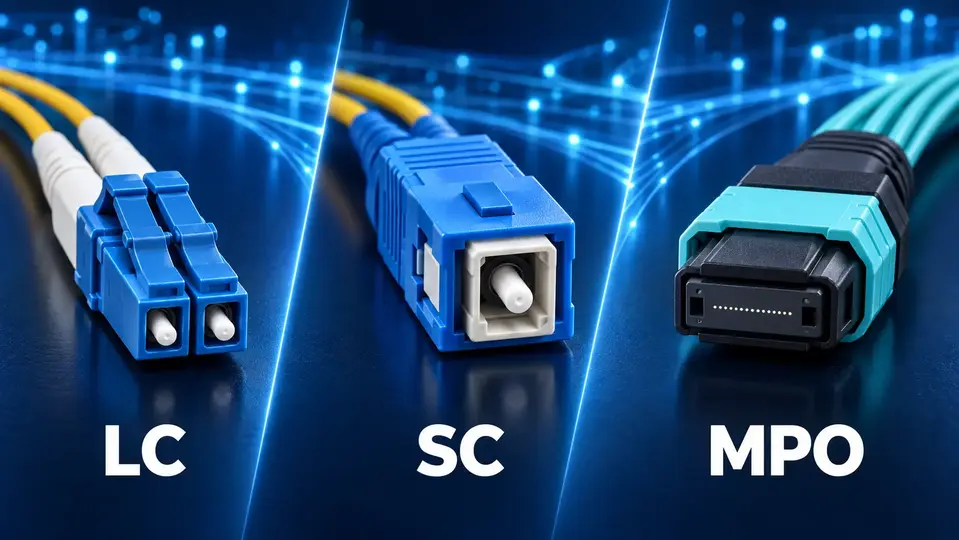
LC, SC, and MPO connectors are used in very different ways. The right choice depends on the equipment interface, the number of fibers required, port density, fiber type, and how the cabling system will be maintained over time.
For many duplex equipment connections, LC is a common starting point. For access-network and distribution environments, SC may match the installed equipment and field convention. For high-density backbone cabling, MPO can consolidate multiple fibers into one interface.
This LC vs SC vs MPO guide compares LC, SC, and MPO connector types from a practical B2B project-planning perspective.
Table of Contents
LC vs SC vs MPO at a Glance
| Factor | LC | SC | MPO |
|---|---|---|---|
| Connection format | Simplex or duplex | Simplex or duplex | Multi-fiber |
| Typical selection context | Equipment-side and high-density patching | Access, distribution, and general fiber patching | Backbone trunks and high-density multi-fiber cabling |
| Main planning priority | Port interface and duplex polarity | Equipment compatibility and polish type | Fiber count, polarity, gender, and key orientation |
| Density consideration | Compact format for dense panels and equipment ports | Larger physical footprint than LC | Consolidates multiple fibers into one connector |
| Project risk to check | Tx/Rx polarity and port compatibility | UPC/APC and installed-interface compatibility | End-to-end polarity plan and component matching |
The connector body alone does not define whether an assembly is suitable. Confirm the full optical path before ordering.
When LC Is the Better Fit
LC connectors are commonly used where compact size and port density are important. They are often considered for equipment-room patching, active-device connections, and duplex optical links.
LC may be a suitable option when the project needs:
- A defined LC equipment interface
- Simplex or duplex connections
- High-density patching
- A consistent labeling and polarity plan
- A manageable path for future adds, moves, and changes
Before selecting LC assemblies, verify the fiber mode, connector polish, port arrangement, cable construction requirements, and the interfaces at both ends.
Do not select LC only because it is small. The active equipment interface and the full channel design should determine the final configuration.
When SC Is the Better Fit
SC connectors are widely encountered in fiber distribution and access-network environments. Their push-pull coupling design can be practical where the equipment, panels, or existing network infrastructure already use SC interfaces.
SC may be considered when the project involves:
- Defined SC ports on equipment or optical distribution hardware
- Access-network or FTTH-related fiber distribution
- Existing SC-based cable plants
- Patch-panel environments where extreme port density is not the main requirement
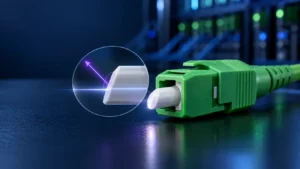
For an SC project, confirm the required fiber type and polish configuration before selecting patch cords, pigtails, adapters, or termination components.
An SC connector may look physically similar across several assemblies, but the required configuration can differ. Check the equipment interface and optical-path requirements instead of relying on appearance alone.
When MPO Is the Better Fit
MPO connectors are designed for multi-fiber connections. They are often evaluated for data-center backbone cabling, high-density trunks, cassette-based systems, and links that need multiple fibers carried through one connector interface.
MPO may be the right approach when a project requires:
- Multi-fiber trunk connections
- High-density backbone cabling
- A cassette or harness transition design
- A documented polarity method
- Coordinated connector gender and key orientation
MPO planning should start before procurement. A trunk cable, cassette, harness, adapter, and equipment-side interface must follow the same documented design. Mixing components without confirming the polarity method can create crossed paths that are difficult to diagnose after installation.
Data Center vs FTTH: Different Connector Priorities
Data Center and Equipment-Room Projects
Data-center planning often focuses on port density, equipment interfaces, structured cabling, breakout architecture, and future upgrade paths.
LC may be relevant for many duplex equipment connections. MPO may be considered where a multi-fiber backbone or a cassette-based design is required. The key is to document the connection architecture, including the transition from trunk connections to equipment-side ports.
Before ordering, confirm:
- Switch, server, or transceiver interface
- Required link architecture
- Fiber mode and cable type
- Duplex or multi-fiber format
- Patch-panel or cassette layout
- Polarity and labeling plan
- Planned upgrade path
FTTH and Access-Network Projects
FTTH and access projects should begin with the active-equipment interface, optical distribution architecture, existing network convention, and required connector polish.
SC connectors may be relevant in these environments, but the final choice must match the actual equipment and project specification. Do not assume that a connector used in one access project will automatically match another network.
Before ordering, confirm:
- OLT, ONT, splitter, or distribution-point interface requirements
- Fiber type and cable application
- Required connector polish
- Adapter and panel configuration
- Indoor or outdoor installation conditions
- Documentation and testing requirements
Five Checks Before You Order
- What connector interface is already defined? Start with the active device, panel, adapter, or installed cable plant. Record the exact interface at each end of the link.
- Is the link single-mode or multimode? Connector type alone does not determine fiber-mode compatibility. Confirm the fiber type and any relevant project requirements before selecting assemblies.
- Do you need simplex, duplex, or multi-fiber connectivity? A standard two-fiber link has different requirements from a multi-fiber backbone. Define the connection format before comparing prices or assembly options.
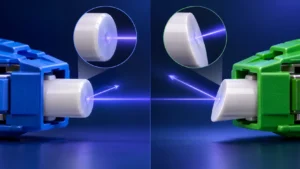
- Does the optical path require UPC or APC? The connector polish must be consistent with the project design. Do not directly mate APC and UPC components.
- If using MPO, is the polarity plan documented? Confirm the fiber count, polarity method, connector gender, key orientation, and all intermediate components. Treat this as an end-to-end system check, not a cable-only decision.
Common Procurement Errors
Ordering by connector shape only
A connector shape does not confirm fiber mode, polish, cable type, or full-channel compatibility.
Treating LC as a universal replacement
LC can be suitable for many high-density equipment connections, but it should not replace an SC-based interface or a multi-fiber architecture without a defined design.
Ignoring UPC and APC differences
A polish mismatch can create optical problems and may damage connector end faces. Confirm the required polish before ordering and before connection.
Overlooking MPO polarity
Multi-fiber systems need consistent polarity across trunks, cassettes, harnesses, and equipment-side connections. Do not mix components without verifying the project design.
Extending an existing system without checking documentation
Legacy connector types, installed fiber, adapters, and equipment interfaces can affect what is compatible. Review the existing network before ordering extensions or replacements.
What to Include in an LC, SC, or MPO RFQ
For a clearer configuration review, provide:
- Connector type required at each end
- Fiber mode and category
- Simplex, duplex, or multi-fiber format
- Required polish type
- Required fiber count for MPO assemblies
- Polarity method, gender, and key orientation where applicable
- Cable or pigtail application
- Required length and quantity
- Installation environment
- Existing equipment, adapter, or patch-panel interface
- Applicable drawings, labeling, or testing requirements
A complete RFQ helps avoid configuration errors caused by missing project information.
Safety Notice
Do not look directly into a fiber connector, open fiber end, transceiver port, or active optical device. Optical radiation may be invisible and can damage eyes.
Before inspecting, cleaning, testing, or reconnecting fiber components, follow the site safety procedure and confirm that the link is inactive or safe to handle. Use appropriate inspection and cleaning tools. Handle fiber shards carefully and dispose of them safely; do not touch bare fiber fragments with unprotected fingers.
FAQ
Is LC better than SC?
Neither connector is universally better. LC is often selected for compact, high-density equipment connections, while SC may suit defined access or distribution interfaces. The equipment port and project design determine the correct choice.
When should I use MPO instead of LC?
MPO is generally considered when a project needs a multi-fiber connection, such as a backbone trunk or a cassette-based high-density design. LC is commonly used for simplex or duplex equipment-side connections.
Can I connect an LC cable directly to an SC port?
Not directly. A defined hybrid assembly or suitable interface arrangement may be needed. Confirm fiber type and polish at both ends.
Can I mix UPC and APC connectors?
No. UPC and APC connectors should not be directly mated. Verify polish type throughout the optical path.
What information should I send before ordering MPO assemblies?
Provide the fiber count, fiber mode, connector configuration at both ends, polarity method, gender, key orientation, length, quantity, and the intended cassette, harness, or equipment interface.
Conclusion
LC, SC, and MPO connectors serve different connection architectures. LC is often chosen for compact simplex or duplex equipment links. SC may fit defined access and distribution interfaces. MPO supports multi-fiber backbone and high-density cabling designs when the polarity plan is fully documented.
Before ordering, confirm the equipment interface, fiber type, connection format, polish requirement, environment, and maintenance plan. For MPO designs, verify the complete end-to-end polarity architecture.
For a project-specific configuration discussion, contact VIBOFIBER with your connector interfaces, fiber type, quantities, and application requirements.
For LC vs SC vs MPO selection, confirm the connector interface, fiber type, polarity method, and installation environment before ordering. For technical connector-interface standards, see IEC 61754.